
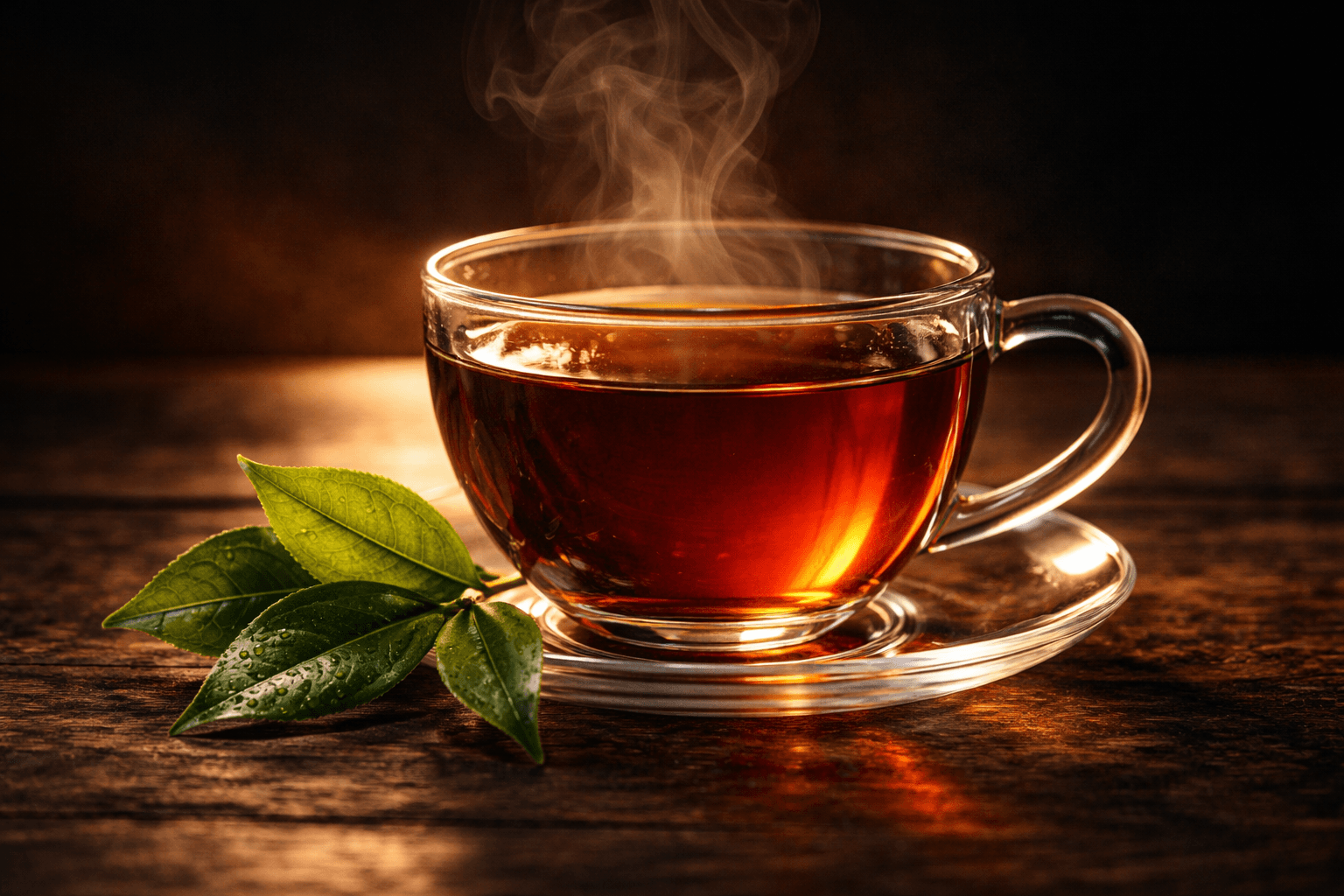
Assam black tea has been a staple in Indian households for generations. Black tea, particularly the robust varieties grown in Assam, contains a range of natural compounds, discussed below, that go beyond simple flavour.
Polyphenols in Every Cup
Black tea contains polyphenols, a group of antioxidant compounds. The main polyphenols in black tea are theaflavins and thearubigins, which are formed during the oxidation process. These compounds give black tea its characteristic dark colour.
Flavonoids in Every Cup
Black tea contains flavonoids, the same broad family of plant compounds found in many fruits and vegetables. In black tea, they come from the oxidation process that gives the leaf its dark colour and bold character.
Balanced Caffeine for Focus
Assam tea contains caffeine, though less than coffee. A typical cup of Assam black tea has roughly 40 to 70 mg of caffeine, the exact amount depends on brew strength and steep time. Black tea also contains L-theanine, an amino acid often discussed alongside caffeine for its role in calm, focused states, though individual responses vary.
A Traditional After-Meal Habit
Black tea contains tannins, compounds also found in wine and many fruits. In traditional Indian households, chai has long been consumed after meals, a habit passed down through generations rather than a clinically established digestive treatment. Milk does reduce some of tea's antioxidant absorption, though most people drink chai with milk regardless, for taste rather than health optimisation.
Brewing Tips
Brewing method affects how much of the tea's natural compounds end up in your cup. Steeping Assam black tea for 3-5 minutes in water at a full rolling boil (100 degrees Celsius) is the traditional method for extracting a full-bodied liquor. Some people add lemon; most Indians prefer their tea with milk and sugar in the traditional chai style.
At Kitaya Industries, we source our black tea from the finest Assam tea gardens where the Camellia sinensis var. assamica plant thrives naturally.