India produces tea at enormous scale, and Assam is consistently the country's largest producing region. With this volume comes a wide range of quality, from exceptional single-garden teas to blended, dust-grade product sold at the lowest prices. If you are buying Assam tea online or in a store, knowing how to evaluate quality can save you from a disappointing cup.
What Separates Good Assam Tea from Average
The quality of Assam tea depends on several factors: the garden it comes from, the flush (harvest season), the grade of the processed leaf, how it was stored, and how recently it was packed.
Upper Assam gardens, particularly those in Dibrugarh, Tinsukia, and Sivasagar districts, tend to produce the boldest and most flavourful teas. The soil in upper Assam has a higher mineral content and the rainfall patterns produce leaves with higher catechin levels. Lower Assam teas tend to be lighter and more neutral in character.
Understanding Tea Grades
CTC tea is graded by granule size and uniformity:
- ◆BP (Broken Pekoe): Coarser granules, strong and fast-brewing
- ◆BOP (Broken Orange Pekoe): Medium granules, balanced extraction
- ◆Fannings and Dust: Finest particles, used mostly in tea bags
Higher grades like BP and BOP produce the best chai. Very fine dust-grade tea brews quickly but can taste harsh and astringent if not precisely timed.
What FSSAI Certification Actually Means
When buying packaged tea in India, this certification matters most.
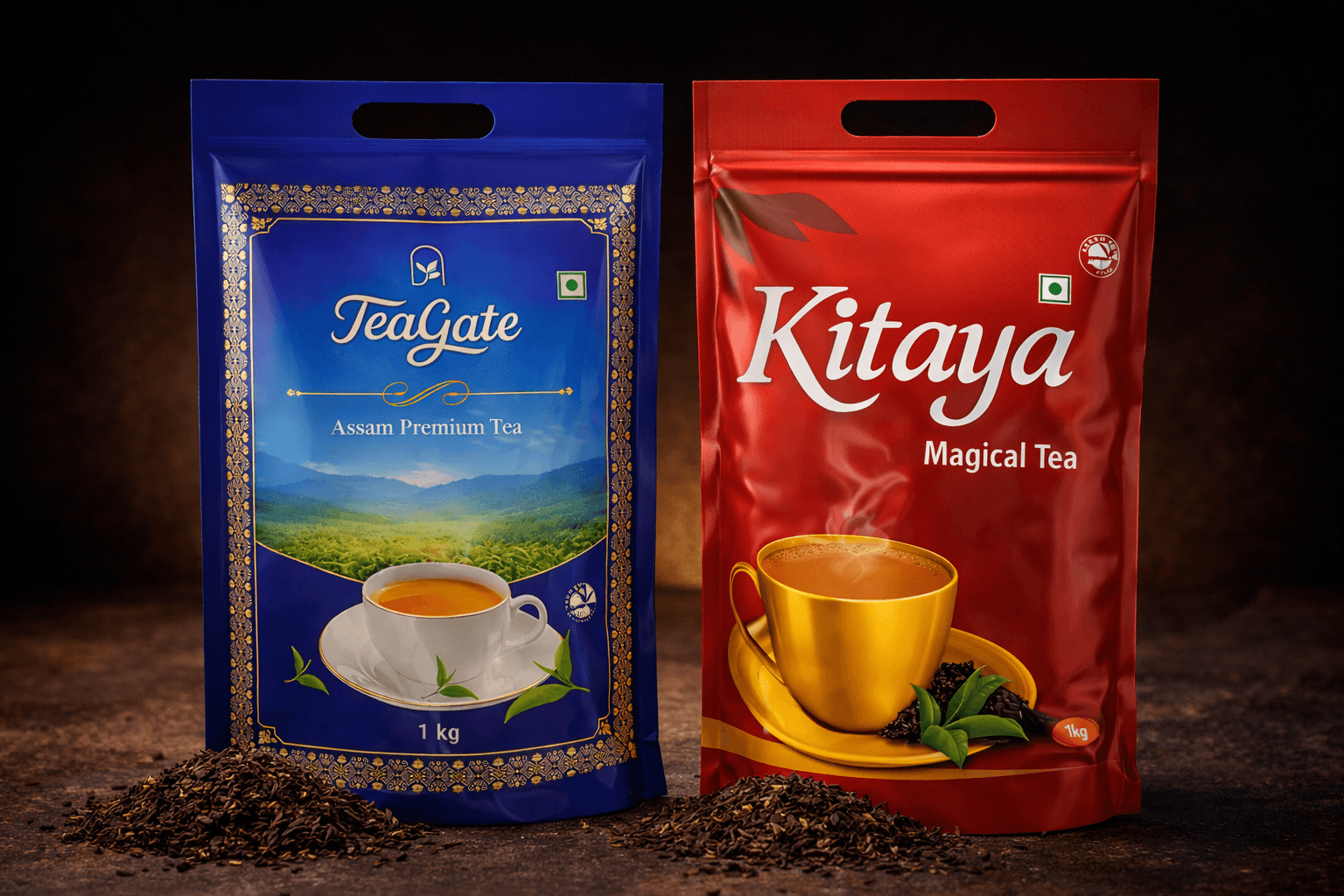
FSSAI (Food Safety and Standards Authority of India) certification means the tea has been manufactured under food safety regulations and has been cleared as safe for consumption. Every legitimate packaged tea brand must carry an FSSAI license number on the packaging. Kitaya Industries holds FSSAI certification, which you can verify on the packaging of both Kitaya and TeaGate products.
The Blending Question
Many packaged tea brands sold in India are blends. A blend combines teas from multiple origins and sometimes multiple flushes to achieve a consistent flavour profile at a lower cost. There is nothing inherently wrong with blending, but it does mean you are not getting a pure Assam product.
Kitaya and TeaGate teas are 100% Assam sourced with no blending. This means the flavour you taste is authentic to the Assam region, including its natural malty character and the specific garden notes from upper Assam.
How to Judge Assam Tea Quality Before You Buy
If you are buying Assam tea loose or in bulk, you can evaluate quality by:
- ◆Colour of dry tea: Good Assam CTC granules should be uniformly dark brown to black. Uneven colouring suggests mixed grades or poor storage
- ◆Aroma of dry tea: Fresh Assam tea has a strong, slightly earthy, malty aroma. Faded aroma means the tea is stale
- ◆Colour of brewed tea: Quality Assam tea should produce a deep reddish-brown to mahogany cup within 2-3 minutes of brewing
- ◆Taste: Clean, bold, slightly malty with natural briskness. No excessive bitterness or flat taste
Kitaya's Direct Sourcing Model
Kitaya Industries is a manufacturer and packer, not a distributor buying from the market. We source directly from Assam tea gardens and pack under FSSAI licensing, fewer intermediaries between the garden and your cup.
Price Guide for Assam Tea in India
Genuine quality Assam CTC tea in India should cost between Rs 250 and Rs 450 per 500g for daily chai grade, and Rs 500 to Rs 900 per 500g for premium single-garden selections. Anything significantly cheaper is likely a blend with lower Assam content or a finer dust grade. Anything priced much higher without clear single-garden provenance may not be offering proportional value.
Kitaya 250g is priced at Rs 99 and the 1kg pack at Rs 396. TeaGate 250g is Rs 119 and the 1kg at Rs 479. Both offer genuine Assam quality at straightforward, transparent prices.